Straight seam steel pipes are widely used in water supply projects, the petrochemical industry, the chemical industry, the power industry, agricultural irrigation, and urban construction. They are one of the twenty key products developed in my country. Straight seam steel pipes are used for liquid transportation: water supply and drainage. They are also used for gas transportation: coal gas, steam, and liquefied petroleum gas. Furthermore, they are used in structural applications: as piling pipes, bridge construction, docks, roads, and building structures.
First, what are the die-casting techniques and reagents for straight seam steel pipes?
1. Casting straight seam steel pipes: This is a pressure processing method that uses the reciprocating impact force of a forging hammer or the pressure of a press to change the billet into the desired shape and size.
2. Extrusion: This is a processing method where metal is placed in a closed extrusion chamber, pressure is applied to one end, and the metal is extruded through a regular die to obtain products with the same shape and size. It is mostly used in the production of non-ferrous metal steel products.
3. Straight seam steel pipe rolling: This is a pressure processing method where steel billets (of various shapes) are passed through the gap between a pair of rotating rollers. The compression of the rollers reduces the cross-section of the material, increasing its length.
4. Drawing steel: This is a processing method where pre-rolled metal billets (shaped, pipe, products, etc.) are drawn through a die to reduce their cross-section and increase their length. It is mostly used for cold working.
Second, what is the die-casting technology for straight seam steel pipes?
The die-casting technology for straight seam steel pipes is no longer a secret. As early as the 1930s, the West discovered that steel, like other softer non-ferrous metals, could be deformed by rolling. This new technology was quickly adopted because it is simple to learn, has low production equipment and basic costs, and produces a wide variety of reliable, widely used straight seam steel pipes. Therefore, technological advancements have received significant attention from researchers. Before this, traditional steel pipe rolling production technology used graphite as a lubricant. However, graphite lubricants have several significant drawbacks:
1. High heat transfer efficiency, poor insulation, rapid mold heating, rapid wear, and difficulty in rolling long products.
2. High carbon content, which can easily lead to intergranular corrosion when producing stainless steel, requiring the removal of the carburized layer after completion, increasing costs.
3. Increased environmental pollution.
Third, what are the advantages of glass lubricants versus graphite lubricants for straight seam steel pipes?
Compared to graphite lubricants, glass lubricants for straight seam steel pipes have the following advantages:
1. Low heat transfer efficiency of glass, resulting in better surface insulation of the workpiece and a longer mold lifespan.
2. Lubrication efficiency is three times higher than graphite, leading to increased production speed and width, thus expanding the product range of the rolling machine.
3. Chemically stable, glass lubricants do not cause structural defects.
4. The concentration of glass can be adjusted to obtain different physical properties (such as softening point, viscosity, etc.) to meet the needs of rolling products from different materials.
5. Clean and environmentally friendly, with no side effects and minimal environmental damage.
In summary, glass lubricant products have excellent performance and are suitable for the production of straight seam steel pipes. Three methods to ensure the required smoothness during the production of straight seam steel pipes are:
1. Rolling Die: The general practice for lubricating the rolling die is to press glass powder into a glass pad. Before the straight seam steel pipe rolling begins, the glass pad is clamped between the steel and the rolling die. To ensure the glass pad's softening effect is maximized under the central friction, the shape of the manufactured glass pad matches the shape of the rolling die inlet cone and the end shape of the steel.
2. Rolling Spool and Mandrel: The glass lubricant used for lubricating the rolling spool and mandrel is in powder form. Its particles are small and have high softening properties. It is then applied to the inner hole and outer surface of the steel. Alternatively, glass cloth can be wrapped around the steel surface, or glass cloth strips can be wrapped around the mandrel.
3. Removal of the glass film on the surface of steel pipes: Due to the use of glass lubricant during the rolling process, a thin glass film remains on the inner and outer surfaces of the rolled steel pipes. This film, like ordinary glass, is hard and brittle, affecting the product after use, so it must be removed. Removal methods include mechanical and chemical methods. Mechanical methods include shot peening, water cooling, and tensile straightening. When using chemical methods to remove the glass film, we know that glass has relatively stable chemical properties, so strong acids or alkalis are used. However, pickling is highly corrosive to various steel pipe materials, potentially causing the steel pipe surface to become acid-washed, especially to carbon steel. Using pickling alone is neither cost-effective nor suitable. Therefore, a combined acid-alkali removal method is now mostly used.
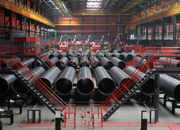 Threeway Steel is known as a professional supplier engaged in manufacturing and distributing a wide range of steel pipe, and our headquarter located the central part of China – Hunan and six associated factories throughout China.
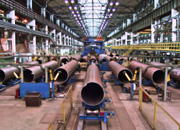 Threeway Steel is known as a professional supplier engaged in designing, manufacturing and distribution of a wide range of steel products with the headquarter located the central part of China – Hunan and six associated factories throughout China.
 Threeway Steel is known as a professional supplier engaged in designing, manufacturing and distribution of a wide range of steel products with the headquarter located the central part of China – Hunan and six associated factories throughout China.
 Threeway Steel is known as a professional supplier engaged in designing, manufacturing and distribution of a wide range of steel products with the headquarter located the central part of China – Hunan and six associated factories throughout China.
 Threeway Steel is known as a professional supplier engaged in designing, manufacturing and distribution of a wide range of steel products with the headquarter located the central part of China – Hunan and six associated factories throughout China.