First, what are the methods for connecting
seamless steel pipes?
1. Compression type: The steel pipe is inserted into the pipe end of the fitting, tightened with a nut, and the steel pipe end is compressed by a screw force through a sealing ring, achieving a seal and completing the connection.
2. Welding type: The ends of the steel pipe are beveled, and a ring weld is performed between the steel pipes manually or automatically.
3. Flange type: A ring argon arc weld is performed between the flange and the steel pipe, and it is tightened with quick clamps or bolts, allowing the gasket between the flanges to provide a seal, completing the connection.
4. Press-fit type: The steel pipe is inserted into the fitting, and a special installation tool is used to press the pipe wall into a hexagonal shape, deforming the internal sealing ring into a hexagonal shape as well.
5. Tapered thread type: The external thread is ring argon arc welded to the steel pipe, and the internal threaded fitting is connected with a tapered thread for sealing, completing the connection.
Second, what is the production process of seamless steel pipes?
1. The production process of seamless steel pipes can be divided into cold drawing and hot rolling. The production process of cold-rolled seamless steel pipes is generally more complex than that of hot-rolled pipes. The steel billet first undergoes three-roll continuous rolling. After extrusion, a sizing test is performed. If there are no cracks on the surface, the round pipe is cut into billets approximately one meter in length.
2. The steel pipe then enters the annealing process. Annealing involves pickling with an acidic liquid. During pickling, attention must be paid to whether a large amount of blistering occurs on the surface of the steel pipe. If a large amount of blistering occurs, it indicates that the quality of the steel pipe does not meet the corresponding standards.
3. Hot-rolled seamless steel pipes are generally delivered in the hot-rolled state after heat treatment. After quality inspection, hot-rolled seamless steel pipes undergo strict manual selection by staff. After quality inspection, the surface is oiled, followed by multiple cold drawing tests. After hot rolling, a piercing test is performed. If the piercing diameter is too large, straightening and correction are required.
4. Hot-rolled seamless steel pipes generally have an outer diameter greater than 32mm and a wall thickness of 2.5-200mm. Cold-rolled seamless steel pipes can have an outer diameter down to 6mm and a wall thickness down to 0.25mm. Thin-walled steel pipes can have an outer diameter down to 5mm and a wall thickness of less than 0.25mm. Cold-rolled pipes have higher dimensional accuracy than hot-rolled pipes.
5. Generally, seamless steel pipes are made from high-quality carbon structural steels such as 10, 20, 30, 35, and 45, low-alloy structural steels such as 16Mn and 5MnV, or alloy structural steels such as 40Cr, 30CrMnSi, 45Mn2, and 40MnB, through hot rolling or cold rolling. Seamless steel pipes made from low-carbon steels such as 10 and 20 are mainly used for fluid transportation pipelines.
6. Seamless steel pipe thread connections include three methods: cylindrical internal threads fitted into cylindrical external threads, cylindrical internal threads fitted into conical external threads, and conical internal threads fitted into conical external threads. The latter two methods provide a tighter connection and are commonly used.
(1) Flange Connection. Flanges are generally used for pipes made of similar materials, such as copper, lead, and plastic. Different methods are used depending on the material being flanged. The flange must be flat and free of cracks and wrinkles.
(2) Threaded Flange Connection. A flange with internal threads is connected to a steel pipe with external threads. This type of flange is mostly made of cast iron and can be used for low-pressure pipeline connections.
(3) Welded Flange Connection. Flanges are welded to steel pipes. This type of flange connection is widely used. The welding method is as follows: Select a pair of flanges and install them on the two ends of the connecting pipes. If the equipment already has flanges, select flanges of the same specification and fit them on the pipe. First, spot-weld a small area to correct the verticality, and finally, weld the flanges firmly to the steel pipe.
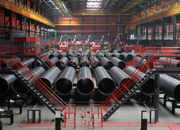 Threeway Steel is known as a professional supplier engaged in manufacturing and distributing a wide range of steel pipe, and our headquarter located the central part of China – Hunan and six associated factories throughout China.
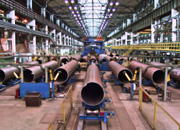 Threeway Steel is known as a professional supplier engaged in designing, manufacturing and distribution of a wide range of steel products with the headquarter located the central part of China – Hunan and six associated factories throughout China.
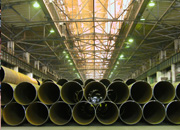 Threeway Steel is known as a professional supplier engaged in designing, manufacturing and distribution of a wide range of steel products with the headquarter located the central part of China – Hunan and six associated factories throughout China.
 Threeway Steel is known as a professional supplier engaged in designing, manufacturing and distribution of a wide range of steel products with the headquarter located the central part of China – Hunan and six associated factories throughout China.
 Threeway Steel is known as a professional supplier engaged in designing, manufacturing and distribution of a wide range of steel products with the headquarter located the central part of China – Hunan and six associated factories throughout China.