First, the causes of misalignment in
large-diameter steel pipes:
1. The nominal outer diameter of large-diameter steel pipes has an allowable positive and negative deviation in the specifications at the time of manufacture. When the positive deviation meets the negative deviation, the total deviation will be at its maximum. Or, the nominal outer diameter itself exceeds the specification, and the "nominal outer diameter" does not meet the standard.
2. Large-diameter steel pipes may undergo certain deformation during manufacturing, transportation, hoisting, and handling, resulting in "out-of-roundness" not meeting the standard.
Second, solutions for misalignment in large-diameter steel pipes:
1. Optimize the alignment methods for large-diameter steel pipes and improve the alignment equipment: Conduct tabletop simulations on how to correctly use external pipe alignment tools and combine them with current hoisting and positioning construction techniques and processes for pipe connections. This involves using alignment tools for correction, specifically for misalignments of less than 3mm, allowing for simultaneous correction and welding.
2. If the misalignment is greater than 5mm, or even exceeding 20mm, a large-diameter pipe alignment tool will not be sufficient. In this case, the pipe end of the large-diameter steel pipe needs to be cut to the size of the smaller end before welding. This requires an on-site plasma cutter, followed by mechanical alignment using shavings. After alignment, the cut opening is then welded together.
3. Finally, during the welding of the pipe joints of large-diameter steel pipes, attention must be paid to the welding current, voltage, welding speed, and weld shape to avoid porosity, slag inclusions, concavity, incomplete penetration, cracks, etc. 24 hours after welding, ultrasonic testing or radiographic inspection should be performed to ensure the welding quality of the treated area and joint.
Third, strict acceptance procedures must be followed for large-diameter steel pipes upon arrival:
Before the large-diameter steel pipes arrive on site, the laboratory must thoroughly review and verify the purchase contract and quality certification documents, including product certificates, material specifications, anti-corrosion layer test reports, and weld quality test reports, ensuring that substandard materials are prevented from entering the project at the source.
- Visual inspection of large-diameter steel pipes: A comprehensive visual quality inspection of the large-diameter steel pipes must be conducted. The surface quality of the large-diameter steel pipes must be checked to ensure there are no serious unevennesses. The weld quality of large-diameter steel pipes is crucial; the welds of spiral submerged arc welded steel pipes should be uniform and continuous, free from defects such as porosity, slag inclusions, and cracks. The outer surface anti-corrosion layer of the large-diameter steel pipes should be intact and undamaged, without bubbles or peeling. Simultaneously, the out-of-roundness of the pipe ends should be checked to facilitate subsequent installation and connection.
- Dimensional and geometric accuracy of large-diameter steel pipes: Using calipers, thickness gauges, and other tools, the key dimensions of the steel pipes, such as the outer diameter, wall thickness, and length, must be accurately measured to ensure compliance with design specifications.
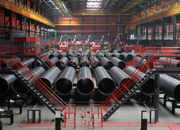 Threeway Steel is known as a professional supplier engaged in manufacturing and distributing a wide range of steel pipe, and our headquarter located the central part of China – Hunan and six associated factories throughout China.
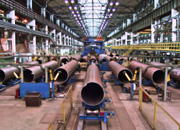 Threeway Steel is known as a professional supplier engaged in designing, manufacturing and distribution of a wide range of steel products with the headquarter located the central part of China – Hunan and six associated factories throughout China.
 Threeway Steel is known as a professional supplier engaged in designing, manufacturing and distribution of a wide range of steel products with the headquarter located the central part of China – Hunan and six associated factories throughout China.
 Threeway Steel is known as a professional supplier engaged in designing, manufacturing and distribution of a wide range of steel products with the headquarter located the central part of China – Hunan and six associated factories throughout China.
 Threeway Steel is known as a professional supplier engaged in designing, manufacturing and distribution of a wide range of steel products with the headquarter located the central part of China – Hunan and six associated factories throughout China.