First, the Core Principles of
Seamless Steel Pipe Fitting Tooling Design.
Precise Positioning Principle: Complex seamless steel pipe fittings (such as bends, reducers, and branched pipes) often have spatial curved surface structures. The tooling needs to achieve six-point positioning. Through a combination of reference surfaces, locating pins, and V-blocks, the translational and rotational degrees of freedom of the fitting are controlled, with a positioning accuracy error of ≤ ±0.02mm, ensuring consistent machining dimensions.
Stable Clamping Principle: Considering the thin walls (minimum wall thickness ≤ 3mm) and poor rigidity of seamless steel pipe fittings, a flexible clamping system with multi-point uniform force distribution is adopted to avoid clamping deformation. Hydraulic/pneumatic clamping mechanisms are preferred, paired with cushioning elements such as elastic bushings and rubber pads. The clamping force can be adaptively adjusted according to the material of the seamless steel pipe fitting (such as stainless steel or alloy steel) (range: 5-30MPa). Adaptability to Complex Structures: For seamless steel pipe fittings with varying bending angles (0°-180°), diameter changes (DN20-DN300), and number of branches (1-4 paths), a modular design is adopted. By replacing positioning modules and clamping components, multi-specification seamless steel pipe fittings can be universally used, achieving a universality rate of≥85%.
Machining Accessibility Principle: The tooling structure must avoid the machining toolpath, reserving sufficient cutting space (tool-to-tool distance ≥10mm). It should also facilitate coolant spraying and chip removal, preventing chip accumulation that could affect machining accuracy.
Second, Core Structure Design of Seamless Steel Pipe Fitting Tooling
(I) Design of Seamless Steel Pipe Fitting Positioning Mechanism.
Reference Positioning Component: Using the end face, axis, or flange face of the seamless steel pipe fitting as a reference, an adjustable positioning plate and positioning pins are installed. The positioning plate is made of wear-resistant alloy steel (Cr12MoV) with quenching treatment (hardness HRC58-62), and the surface is ground to achieve a flatness of ≤0.01mm. The positioning pin adopts a floating structure to compensate for minor deviations in the reference surface of the seamless steel pipe fitting. Curved Surface Positioning Module: For bent pipes and arc-shaped fittings, a fitted V-block or arc-shaped positioning seat is designed. The included angle of the V-block is adjusted according to the pipe diameter (60°-120°). The inner surface of the arc-shaped positioning seat is wire-cut, and the fit with the outer circle of the seamless steel pipe fitting is ≥90%, preventing the seamless steel pipe fitting from shifting during processing.
(II) Seamless Steel Pipe Fitting Clamping Mechanism Design.
Hydraulic Clamping Unit: Driven by a double-acting hydraulic cylinder, paired with a lever-type clamping arm, the clamping stroke is adjustable (5-20mm). For thin-walled seamless steel pipe fittings, a polyurethane pad is installed at the end of the clamping arm to ensure uniform contact pressure distribution and avoid excessive local stress that could cause deformation of the seamless steel pipe fitting. Linked Clamping Structure: For multi-branched seamless steel pipe fittings (such as tees and crosses), a linked clamping mechanism is designed. A single power source enables synchronous clamping at multiple points, ensuring consistent positioning accuracy at each branch point. The clamping repeatability error is ≤ ±0.015mm.
(III) Auxiliary Support Structure for Seamless Steel Pipe Fittings.
Adjustable Support Pin: For slender seamless steel pipe fittings with a length-to-diameter ratio greater than 10, an adjustable support pin is installed in the center of the fixture. Made of hard alloy, the pin's support height and clamping force can be adjusted via a handwheel, effectively suppressing vibration and deflection deformation during seamless steel pipe fitting processing.
Anti-Torsion Limiting Block: An anti-torsion limiting block is installed on the non-machined surface of the seamless steel pipe fitting. This block cooperates with the flat or grooved structure of the fitting to restrict rotation around the axis, ensuring the positional accuracy of features such as threads and keyways during processing.
Third, Key Technical Points of Seamless Steel Pipe Fittings:
Material Selection and Heat Treatment: The main frame of the tooling is welded from Q235B steel plate, and internal stress is eliminated through aging treatment. Positioning and clamping elements are made of high-strength alloy steel and are quenched and tempered to improve wear resistance and service life, ensuring the long-term accuracy and stability of the tooling.
Precision Compensation Design: Considering the manufacturing errors of seamless steel pipe fittings (such as roundness and straightness errors), a micro-adjustment mechanism (such as thread fine-tuning and shim compensation) is set in the tooling positioning mechanism to correct installation errors of the seamless steel pipe fittings in real time, ensuring the accuracy of the processing benchmark.
Compatibility Optimization: Through standardized interface design, the tooling can be quickly adapted to different models of machining centers (vertical and horizontal), while retaining expansion interfaces to facilitate the subsequent addition of automated loading and unloading devices (such as robotic arms and conveyor lines), improving processing efficiency.
Fourth, Application Case Analysis
Taking the processing of a DN150 stainless steel bent pipe for engineering machinery as an example, this seamless steel pipe fitting has a bending angle of 90°, a wall thickness of 5mm, and requires processing of the flange faces at both ends and the stepped holes on the inner wall, with a dimensional tolerance requirement of ±0.03mm. The above tooling design scheme is adopted:
Positioning Mechanism: Using the end faces of the bent pipe as a reference, an arc-shaped positioning seat and a floating positioning pin are used to achieve six-point positioning.
Clamping Mechanism: Hydraulic linkage clamping is adopted, with two clamping points on each flange face and an adjustable support pin in the middle.
Processing Effect: Actual processing verification shows that the flatness of the flange face of the seamless steel pipe fitting is ≤0.02mm, the coaxiality of the stepped holes on the inner wall is ≤0.025mm, and the clamping deformation is ≤0.01mm, fully meeting the design requirements. The processing efficiency is increased by 40% compared to traditional tooling, and the scrap rate is reduced from 3.5% to 0.8%.
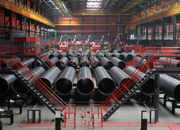 Threeway Steel is known as a professional supplier engaged in manufacturing and distributing a wide range of steel pipe, and our headquarter located the central part of China – Hunan and six associated factories throughout China.
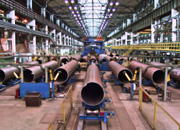 Threeway Steel is known as a professional supplier engaged in designing, manufacturing and distribution of a wide range of steel products with the headquarter located the central part of China – Hunan and six associated factories throughout China.
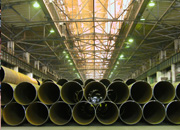 Threeway Steel is known as a professional supplier engaged in designing, manufacturing and distribution of a wide range of steel products with the headquarter located the central part of China – Hunan and six associated factories throughout China.
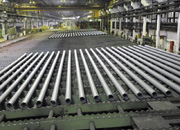 Threeway Steel is known as a professional supplier engaged in designing, manufacturing and distribution of a wide range of steel products with the headquarter located the central part of China – Hunan and six associated factories throughout China.
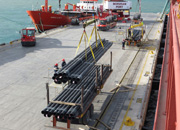 Threeway Steel is known as a professional supplier engaged in designing, manufacturing and distribution of a wide range of steel products with the headquarter located the central part of China – Hunan and six associated factories throughout China.