Straight seam welded steel pipes do not refer to a specific type of steel pipe, but rather a broad category of welded steel pipes. They are made from steel strips and manufactured using high-frequency welding equipment. Simply put, straight seam welded steel pipes are those where the weld seam is on the same straight line during the welding process.
Based on different uses and subsequent production processes, steel pipes can be broadly categorized into scaffolding steel pipes, fluid steel pipes, electrical conduits, support pipes, and guardrail steel pipes. Low-pressure fluid-welded steel pipes are a type of straight-seam welded steel pipe. After welding, another water pressure test is conducted for water and gas transport. Therefore, the price of low-pressure fluid pipes is generally higher than that of ordinary longitudinally welded steel pipes. For example, 1-inch (DN25) (i.e., 33.5 * 3.25) fusion-welded steel pipes for fluid transport are also called welded steel pipes. After bending, they are welded together with steel plates or strips. According to the weld seam form, they can be divided into straight-seam welded steel pipes and spiral welded steel pipes. According to applications, they can be divided into ordinary welded steel pipes, galvanized welded steel pipes, oxygen-blown welded steel pipes, electrical conduits, transformer pipes, thin-walled steel pipe fusion, special-shaped steel pipe fusion, and spiral welded steel pipes.
General-purpose welded steel pipe: This type of welded steel pipe is mainly used for transporting low-pressure liquids or fluids. Of course, besides these types of steel, some easily weldable steels can also be used to manufacture general-purpose welded steel pipes. There are certain requirements for surface quality; these pipes must undergo tests such as water pressure, bending, and flattening.
Double-sided submerged arc welded straight seam steel pipe is also a type of straight seam steel pipe. Submerged arc welded steel pipe uses the JCOE cold forming process, with welding wire for the weld and granular flux for submerged arc welding. The main production process of submerged arc welded straight seam steel pipe is flexible, allowing for the production of any specifications with wall thicknesses from 325 to 1420 mm, meeting customer requirements for pipe dimensions. Domestic standard production typically uses high-frequency straight seam steel pipe, often referred to as "original steel pipe." This industry terminology differs from submerged arc welded straight seam steel pipe or thermal expansion high-frequency straight seam steel pipe, and their names are often confused.
Precautions for the Use of Straight Seam Steel Pipes
The installation and use of straight seam steel pipes have strict process requirements and must be carried out according to actual conditions and operating procedures to ensure quality. Before using straight seam steel pipes, construction preparation is necessary. This includes excavating pipe trenches and completing pipe well construction, as well as preparing equipment such as welding machines, cutting machines, electric hammers, and polishing machines. Installation can only begin after all equipment is ready.
The installation of straight seam steel pipes involves positioning the pipeline according to the design drawings, prefabricating pipe supports according to site conditions, cutting materials according to the design and on-site conditions, polishing grooves with a polishing machine, and then welding.
Quality requirements for the use of straight seam steel pipes: branch pipes should not be welded at the weld seam; welding should be avoided at bends; the deviation per meter for vertical installation should be less than 3 mm; the deviation per meter for horizontal installation should be less than 1 mm; the weld seam should be straight and full, with no burn-through or cracks on the weld surface.
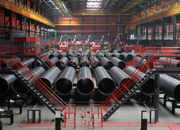 Threeway Steel is known as a professional supplier engaged in manufacturing and distributing a wide range of steel pipe, and our headquarter located the central part of China – Hunan and six associated factories throughout China.
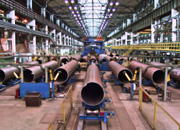 Threeway Steel is known as a professional supplier engaged in designing, manufacturing and distribution of a wide range of steel products with the headquarter located the central part of China – Hunan and six associated factories throughout China.
 Threeway Steel is known as a professional supplier engaged in designing, manufacturing and distribution of a wide range of steel products with the headquarter located the central part of China – Hunan and six associated factories throughout China.
 Threeway Steel is known as a professional supplier engaged in designing, manufacturing and distribution of a wide range of steel products with the headquarter located the central part of China – Hunan and six associated factories throughout China.
 Threeway Steel is known as a professional supplier engaged in designing, manufacturing and distribution of a wide range of steel products with the headquarter located the central part of China – Hunan and six associated factories throughout China.