BA grade stainless steel seamless pipes are high-precision products among stainless steel pipes. Their core characteristic is that a bright annealing process achieves a non-oxidized surface and high gloss, while ensuring mechanical properties and corrosion resistance. They are widely used in fields with extremely high requirements for cleanliness and surface quality, such as semiconductors, food and pharmaceuticals, and precision instruments. The production process requires strict control over the precision and cleanliness of each step, specifically divided into six core stages: raw material preparation, hot rolling, cold rolling finishing, bright annealing, finishing inspection, and finished product packaging. Details of each stage are as follows:
First, the raw material preparation stage for BA grade stainless steel seamless pipes.
BA grade stainless steel pipes have extremely high requirements for raw material purity (e.g., for 304/316L stainless steel, C≤0.03% and S≤0.015% must be controlled to avoid impurities affecting corrosion resistance and surface quality). The core of this stage is selecting qualified billets and pre-treating them:
1. Billet Selection
Stainless steel round billets conforming to ASTM or GB standards (such as 304, 316L, 317L, etc., austenitic stainless steel) are used. The billet diameter is determined according to the finished stainless steel pipe specifications (usually φ80-200mm). Chemical composition must be tested through spectral analysis to ensure that the content of alloying elements such as Cr, Ni, and Mo meets the standards, avoiding internal defects such as inclusions and shrinkage cavities.
2. Billet Pretreatment
(1) Surface Cleaning: Remove oxide scale, oil, and impurities from the billet surface by shot blasting or pickling (nitric acid + hydrofluoric acid mixture) to prevent defects from transferring to the finished product surface during rolling;
(2) Heating: Send the cleaned billet into a continuous heating furnace and heat it uniformly at 850-1200℃ (adjusted according to steel grade) to soften the billet to a plastic state, preparing it for subsequent piercing (the heating atmosphere needs to be controlled to avoid oxidation).
Second, the Hot Rolling Stage of BA Grade Stainless Steel Seamless Pipe.
This stage involves hot processing to roll the round billet into a "rough tube" (i.e., a preliminary seamless steel pipe). The core is to ensure that the stainless steel pipe has a uniform wall thickness and no cracks. Specific steps:
1. Piercing: The heated round billet is sent into a two-roll skew rolling piercing mill. Through the cooperation of two rollers rotating at a certain angle and a centering mandrel, the solid round billet is rolled into a hollow "rough tube" (the inner diameter is determined by the mandrel diameter, and the outer diameter is controlled by the roller spacing). This step requires strict control of the roll speed and mandrel position to avoid defects such as uneven wall thickness and inward folds in the tube.
2. Hot Rolling & Elongation: The tube is fed into a continuous tube mill (MPM) or an automatic tube mill (AZM), where it is continuously rolled by multiple sets of rolls to bring the outer diameter and wall thickness close to the finished product specifications (i.e., the "raw tube"). Rolling oil lubrication is required during the rolling process to reduce roll wear and surface scratches.
3. Sizing & Reducing: The raw tube is fed into a sizing mill, where precision rolls calibrate the outer diameter to the standard size (error ≤ ±0.1mm). If a smaller outer diameter is required, it is fed into a reducing mill, where multiple rolling passes reduce the outer diameter while ensuring uniform wall thickness.
4. Cooling and Straightening: After hot rolling, the rough tube is first cooled to room temperature by water or air to avoid high-temperature oxidation; then it is fed into a multi-roll straightener to correct the curvature of the stainless steel tube (BA grade stainless steel tubes require a straightness ≤1mm/m) to ensure the accuracy of subsequent processing.
Third, Cold Rolling Finishing Stage of BA Grade Stainless Steel Seamless Tubes.
The surface roughness (Ra≈5-10μm) of the hot-rolled rough tube cannot meet the BA grade requirements, and further surface refinement and dimensional tolerance control are required through cold rolling:
1. Pickling & Degreasing
Before cold rolling, the oxide scale and rolling oil on the surface of the rough tube are removed:
(1) Pickling: Immerse in a mixed solution of nitric acid and hydrofluoric acid to dissolve the surface oxide scale (to avoid a residual oxide layer affecting the surface quality of cold rolling);
(2) Degreasing: Clean the rolling oil with alkaline cleaning agents or organic solvents to prevent oil from embedding into the surface during cold rolling.
2. Cold Rolling: The pickled rough tube is fed into a cold rolling mill (such as an LD or LG mill). Through a combination of rolls and mandrels, the stainless steel tube undergoes multiple cold rolling passes (each pass reducing diameter/wall thickness by 10%-20%), ultimately achieving:
(1) Dimensional accuracy: Outer diameter tolerance ≤ ±0.05mm, wall thickness tolerance ≤ ±5%;
(2) Surface roughness: Ra reduced to 0.8-1.6μm (preparing for subsequent bright annealing).
Cold rolling lubricating oil (usually extreme pressure lubricating oil) must be used during the cold rolling process, and the rolling speed must be controlled (10-30m/min) to avoid surface scratches.
3. Degreasing and Cleaning: Immediately after cold rolling, residual cold rolling oil is removed by spray cleaning + ultrasonic cleaning, ensuring that the oil residue is ≤5mg/m² (oil stains can cause black spots on the surface during bright annealing, affecting gloss).
Fourth, the bright annealing stage of BA-grade stainless steel seamless pipes.
Bright annealing is the core difference between BA grade stainless steel pipes and ordinary stainless steel pipes. Annealing in a protective atmosphere eliminates cold-rolled internal stress, improves mechanical properties, and prevents surface oxidation. The specific process is as follows:
1. Atmosphere preparation.
High-purity inert gases (such as 99.999% hydrogen, nitrogen, or a hydrogen-nitrogen mixture) are used as the protective atmosphere to ensure that the oxygen content in the annealing furnace is ≤10ppm (excessive oxygen content will cause surface oxidation and discoloration).
2. Annealing Process Control
The degreased cold-rolled stainless steel tube is fed into a continuous bright annealing furnace, and the “heating-holding-cooling” curve is strictly controlled:
(1) Heating stage: The temperature is increased to 900-1100℃ at a rate of 5-10℃/min (usually 1050℃ for 304 steel and 1080℃ for 316L steel);
(2) Holding stage: The tube is held at the target temperature for 30-60 minutes to eliminate work hardening caused by cold rolling and restore the toughness of the stainless steel (hardness ≤ HV200 after annealing);
(3) Cooling stage: Rapid cooling (such as water cooling or strong air cooling) is used to rapidly cool the stainless steel tube from the annealing temperature to below 200℃ to avoid grain growth affecting mechanical properties while maintaining surface gloss.
3. Surface Inspection
After annealing, the surface of the stainless steel pipe should exhibit a uniform silvery-white luster, free of oxidation colors (such as blue, yellow, or black spots), and a surface roughness Ra≤0.4μm (some high-end BA stainless steel pipes require Ra≤0.2μm).
Fifth, Finishing and Inspection Stage of BA Grade Stainless Steel Seamless Pipes.
As a high-precision product, BA grade stainless steel pipes require multi-dimensional inspection to eliminate unqualified products, and undergo fine finishing:
1. Pipe Cutting and Chamfering
According to the customer's order length (e.g., 6m, 3m), use a CNC pipe cutting machine (e.g., laser cutting, plasma cutting) for precise cutting, with a cut perpendicularity error ≤0.5°; subsequently, chamfer the stainless steel pipe ends (internal and external chamfering) to avoid sharp edges scratching or creating burrs.
(1) Non-destructive testing (NDT)
(2) Ultrasonic testing (UT): Detects internal defects such as cracks and inclusions in stainless steel pipes (detection sensitivity ≥ Φ2.0mm flat-bottomed hole);
(3) Eddy current testing (ET): Detects surface and near-surface defects in stainless steel pipes (such as scratches and pinholes; defects with a depth ≤ 0.1mm can be detected);
(4) Hydrostatic testing: Performs a hydrostatic test on the stainless steel pipe (test pressure ≥ 1.5 times the design pressure), holding the pressure for 30 seconds without leakage to ensure sealing.
2. Dimensional and surface inspection
(1) Dimensional measurement: Uses a laser diameter gauge and micrometer to measure the outer diameter and wall thickness, ensuring tolerances meet standards (such as ASTM A269, GB/T 14976);
(2) Surface inspection: Inspects the surface quality visually (under strong light) or with a surface roughness tester, ensuring no defects such as oxidation, scratches, or pits are allowed.
(3) Re-inspection of Chemical Composition and Mechanical Properties: Sampling is conducted for spectral analysis (to confirm chemical composition) and mechanical property testing (tensile test, hardness test) to ensure tensile strength ≥ 515 MPa, yield strength ≥ 205 MPa, and hardness ≤ HV200 (304 steel standard).
Sixth, Finished Product Packaging Stage of BA Grade Stainless Steel Seamless Pipes.
BA grade stainless steel pipes have extremely high cleanliness requirements. Packaging must avoid surface contamination and scratches:
1. Cleaning Treatment
After passing inspection, the inside of the stainless steel pipe is cleaned with pure water to remove residual impurities; some high-end fields (such as semiconductors) require ultrasonic cleaning + vacuum drying to ensure the cleanliness of the stainless steel pipe is ≤ 100 class (ISO 14644).
2. Packaging Method
(1) Inner Packaging: Each stainless steel pipe is wrapped in food-grade polyethylene film, with both ends sealed with plastic plugs to prevent dust and moisture from entering the pipe.
(2) Outer Packaging: Multiple stainless steel pipes are packed into wooden crates or stainless steel pallets. Moisture-proof paper is placed inside the crate, and the pallet is wrapped with stretch film, clearly labeled with product specifications, batch number, material, and other information.
3. Storage and Transportation
Finished stainless steel pipes should be stored in a clean, dry, and well-ventilated warehouse (temperature 5-30℃, humidity ≤60%), avoiding contact with corrosive substances. Handle with care during transportation to prevent deformation or surface scratches caused by violent collisions.
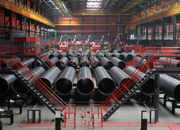 Threeway Steel is known as a professional supplier engaged in manufacturing and distributing a wide range of steel pipe, and our headquarter located the central part of China – Hunan and six associated factories throughout China.
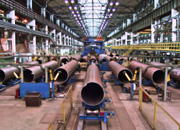 Threeway Steel is known as a professional supplier engaged in designing, manufacturing and distribution of a wide range of steel products with the headquarter located the central part of China – Hunan and six associated factories throughout China.
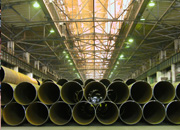 Threeway Steel is known as a professional supplier engaged in designing, manufacturing and distribution of a wide range of steel products with the headquarter located the central part of China – Hunan and six associated factories throughout China.
 Threeway Steel is known as a professional supplier engaged in designing, manufacturing and distribution of a wide range of steel products with the headquarter located the central part of China – Hunan and six associated factories throughout China.
 Threeway Steel is known as a professional supplier engaged in designing, manufacturing and distribution of a wide range of steel products with the headquarter located the central part of China – Hunan and six associated factories throughout China.