First, Core Technological Directions for Ensuring the Processing Strength of
Seamless Steel Pipe Fittings
Seamless steel pipe fittings for engineering machinery must withstand vibration and impact, high-pressure loads, and corrosion under harsh working conditions. Ensuring processing strength requires focusing on four core areas: material performance optimization, structural stress control, improved processing accuracy, and surface strengthening and protection. This ensures that seamless steel pipe fittings meet the requirements of tensile strength ≥800MPa, yield strength ≥650MPa, and fatigue life ≥10⁶ cycles.
Second, Key Implementation Points of Seamless Steel Pipe Fittings
(I) Material Pretreatment and Performance Optimization of Seamless Steel Pipe Fittings
1. Raw Material Screening and Inspection: High-strength alloy steel pipes are preferred. Before warehousing, internal defects are detected by ultrasonic testing to ensure that the raw materials have no hidden dangers affecting strength. Chemical composition analysis is performed on the steel pipes to control carbon and manganese content, ensuring a balance between weldability and mechanical strength.
2. Pre-treatment process: Before processing, a quenching and tempering treatment is used to control the hardness of the steel pipe to HRC28-32, eliminating internal stress during rolling and improving material toughness and uniformity. For thin-walled seamless steel pipe fittings, low-temperature aging treatment is used to avoid deformation during subsequent processing.
(II) Processing Strength Control of Seamless Steel Pipe Fittings
1. Cutting parameter optimization: A cutting strategy of "high speed, low feed, and small depth of cut" is adopted to reduce the impact of cutting forces on the seamless steel pipe fittings and avoid excessively thick work-hardened layers or micro-cracks. For high-strength steel pipes, PCBN tools are selected, with cutting speed controlled at 80-120 m/min and feed rate at 0.1-0.2 mm/r, reducing machining quality fluctuations caused by tool wear.
2. Structural Stress Control: During the machining of bifurcated seamless steel pipe fittings, a "step-by-step cutting + intermediate annealing" process is adopted. After machining each bifurcation section, low-temperature annealing is performed to release local stress. Thread machining uses roll forming instead of cutting, creating a work-hardened layer on the thread surface and avoiding stress concentration caused by cutting grooves, increasing thread connection strength by over 30%.
3. Coordinated Tool Holder and Fixture Deformation Prevention: When machining slender seamless steel pipe fittings with a length-to-diameter ratio > 12, a dual support system of "tool holder + auxiliary ejector pin" is used. The tool holder support force is increased by 20%-30% compared to ordinary seamless steel pipe fittings, suppressing deflection deformation caused by cutting vibration. When clamping thin-walled seamless steel pipe fittings, flexible pads and multi-point linkage clamping are used, with a clamping force error ≤ ±5%, avoiding plastic deformation caused by local stress exceeding the material's yield limit.
(III) Precision and Geometric Tolerance Control of Seamless Steel Pipe Fittings
1. Principle of Unified Datum: The axis or end face of the seamless steel pipe fitting is used as the unified datum throughout the entire process. When machining various features, the geometric tolerances are controlled as follows: coaxiality ≤ 0.03mm, perpendicularity ≤ 0.02mm, and flatness ≤ 0.02mm to avoid additional stress during assembly.
2. Optimization of Machining Allowance: The "minimum allowance principle" is adopted. The roughing allowance is controlled at 2-3mm, and the finishing allowance is 0.3-0.5mm, reducing uneven stress release during material removal. For bent seamless steel pipe fittings, straightness errors are corrected using a straightening machine before machining to ensure the accuracy of the machining datum.
(IV) Surface Strengthening and Protection of Seamless Steel Pipes and Fittings
1. Surface Hardening Treatment: Induction hardening is applied to critical load-bearing areas, resulting in a hardened layer depth of 2-4 mm and a surface hardness of HRC45-55, improving wear resistance and impact resistance. After machining, the inner wall undergoes shot blasting to remove oxide scale and burrs, while simultaneously creating uniform residual compressive stress to inhibit fatigue crack initiation.
2. Corrosion Protection Treatment: Seamless steel pipes and fittings used outdoors employ a "phosphating + electrophoretic coating" process, with a coating thickness ≥80 μm and a salt spray test life ≥1000 h. Internal channels such as hydraulic pipelines undergo passivation treatment to remove surface oil and impurities, preventing corrosion failure caused by hydraulic oil contamination.
(V) Welding Strength Guarantee for Seamless Steel Pipe Fittings
1. Welding Process Optimization: Argon arc welding for the root pass + submerged arc welding for the fill pass, welding current 180-220A, voltage 24-28V, welding speed 3-5mm/s, avoiding defects such as incomplete penetration and porosity; post-weld stress-relieving annealing to eliminate residual welding stress.
2. Weld Quality Inspection: X-ray inspection is used to detect internal weld defects, and ultrasonic testing is used to detect incomplete penetration at the weld root. The tensile strength of the weld is not less than 90% of the base metal strength.
Thrid. Strength Verification and Testing Scheme for Seamless Steel Pipe Fittings
1. Mechanical Property Testing: Three samples are randomly selected from each batch for tensile testing, impact testing, and fatigue testing to ensure compliance with engineering machinery usage requirements.
2. Non-destructive Testing: After processing, seamless steel pipe fittings undergo 100% ultrasonic and magnetic particle testing, with penetrant testing used for verification of critical parts.
3. Working Condition Simulation Tests: For pressure-bearing seamless steel pipe fittings such as hydraulic pipelines, hydrostatic tests are conducted; for structural components, vibration and impact tests are performed to verify strength stability under actual working conditions.
Fourth, Typical Applications of Seamless Steel Pipe Fittings.
Case Study: A certain excavator uses DN125, 6mm thick 20CrMnTi seamless steel pipe bends, which need to withstand high-pressure hydraulic oil and vibration impact. The following technical solution is adopted:
Pretreatment: Quenching and tempering, hardness HRC30;
Machining: PCBN tool cutting, thread rolling, follower holder + auxiliary ejector pin support, preload 8MPa;
Strengthening: Flange surface induction hardening, inner wall shot blasting, outer wall electrophoretic coating; Verification: Tensile strength 860MPa, yield strength 720MPa, impact energy at -20℃ 55J, hydrostatic test 52.5MPa pressure holding for 30min without leakage, fatigue test 10⁶ cycles without cracks, meeting the excavator's 5000h service life requirement.
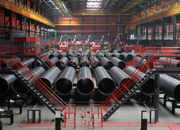 Threeway Steel is known as a professional supplier engaged in manufacturing and distributing a wide range of steel pipe, and our headquarter located the central part of China – Hunan and six associated factories throughout China.
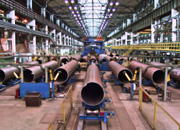 Threeway Steel is known as a professional supplier engaged in designing, manufacturing and distribution of a wide range of steel products with the headquarter located the central part of China – Hunan and six associated factories throughout China.
 Threeway Steel is known as a professional supplier engaged in designing, manufacturing and distribution of a wide range of steel products with the headquarter located the central part of China – Hunan and six associated factories throughout China.
 Threeway Steel is known as a professional supplier engaged in designing, manufacturing and distribution of a wide range of steel products with the headquarter located the central part of China – Hunan and six associated factories throughout China.
 Threeway Steel is known as a professional supplier engaged in designing, manufacturing and distribution of a wide range of steel products with the headquarter located the central part of China – Hunan and six associated factories throughout China.