NACE MR0175 is not a specific
seamless steel pipe material, but rather a standard developed by the National Association of Corrosion Engineers (NACE), officially titled "Sulfide Stress Crack Resistance Metallic Materials for Oilfield Equipment." In 2003, this standard was revised and renamed NACE MR0175/ISO 15156 "Oil and Gas Industry — Materials for H2S-Containing Environments in Oil and Gas Production." The following is an analysis of the material composition of seamless steel pipes conforming to the NACE MR0175/ISO 15156 standard:
First, what are the chemical composition requirements for NACE MR0175 seamless steel pipes?
Sulfur Content: For seamless products, the S content is not greater than 0.01%; for rolled products (steel plate), the S content is not greater than 0.003%; for forged products, the S content is less than 0.025%. Reducing the sulfur content in steel increases its resistance to sulfide stress corrosion.
Phosphorus content: Generally, P ≤ 0.020%. Excessive phosphorus content reduces the toughness and corrosion resistance of steel. Controlling its content helps improve the performance of steel pipes in sulfur-containing environments.
Carbon content: Typically, C ≤ 0.10%. Excessive carbon content increases the hardness of steel, reduces toughness, and is detrimental to resistance to sulfide stress corrosion cracking. Lower carbon content improves the corrosion resistance of steel.
Nickel content: In carbon steel and low-alloy steel, the Ni content is less than 1%. Excessive nickel content may increase the steel's susceptibility to sulfide stress corrosion cracking.
Second, what are the mechanical property requirements for NACE MR0175 seamless steel pipes?
Hardness: The hardness of carbon steel and low-alloy steel should not exceed 22 HRC (Rockwell hardness). Forgings manufactured according to ASTM A105 should have a hardness not exceeding 187 HBW (Brinell hardness); forgings according to ASTM A234 WPB and WPC should have a hardness not exceeding 197 HBW (Brinell hardness); the maximum hardness of the weld zone should not exceed 250 HV (Vickers hardness) or 22 HRC (Rockwell hardness).
Strength: Tensile strength and yield strength should be consistent with the requirements of relevant standards for general steel pipes, and must meet the mechanical performance requirements under actual use conditions to ensure that the steel pipe will not fail under pressure and external forces.
Third, what are the heat treatment requirements for NACE MR0175 seamless steel pipes?
The base material should be non-free-cutting steel and belong to one of the following heat treatment states: hot rolling, annealing, normalizing, normalizing + tempering, austenitizing, quenching and tempering, austenitizing, quenching and tempering. Carbon steel and low-alloy steel should undergo stress-relieving heat treatment after rolling, cold forging, or other manufacturing processes that result in permanent deformation of the outer fiber layer exceeding 5%. However, cold-worked pipeline fittings of ASTM A53 B, ASTM A106 B, API 5L X42, or equivalent grades do not require heat treatment if the cold deformation does not exceed 15% and the hardness is not greater than 197 HBW.
Fourth, what other requirements are there for NACE MR0175 seamless steel pipes?
Marking: Low-stress markings should be used; if high-stress markings are used, stress-relieving heat treatment at a temperature not lower than 595℃ should be performed after marking.
Testing: When requested by the customer, SSC, SOHIC, and SZC soft zone cracking tests should be conducted. The test methods and evaluation should be performed in accordance with NACE standards.
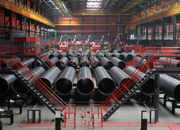 Threeway Steel is known as a professional supplier engaged in manufacturing and distributing a wide range of steel pipe, and our headquarter located the central part of China – Hunan and six associated factories throughout China.
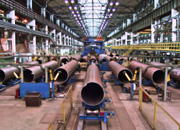 Threeway Steel is known as a professional supplier engaged in designing, manufacturing and distribution of a wide range of steel products with the headquarter located the central part of China – Hunan and six associated factories throughout China.
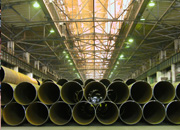 Threeway Steel is known as a professional supplier engaged in designing, manufacturing and distribution of a wide range of steel products with the headquarter located the central part of China – Hunan and six associated factories throughout China.
 Threeway Steel is known as a professional supplier engaged in designing, manufacturing and distribution of a wide range of steel products with the headquarter located the central part of China – Hunan and six associated factories throughout China.
 Threeway Steel is known as a professional supplier engaged in designing, manufacturing and distribution of a wide range of steel products with the headquarter located the central part of China – Hunan and six associated factories throughout China.