Introduction to Large-Diameter Straight Seam Welded Pipe Manufacturing
Large-diameter straight seam welded pipes are essential for critical infrastructure, including oil and gas transmission, water pipelines, and offshore engineering. Designed to withstand high pressure over long distances, their structural integrity relies heavily on geometric precision—such as roundness, diameter consistency, and straightness—to prevent stress concentration and ensure safe operation.
To achieve superior dimensional accuracy, advanced forming technologies like COE (Continuous On-line Expansion) and UOE (U-ing and O-ing) are widely utilized. These processes shape steel plates into cylinders before submerged arc welding (SAW), playing a decisive role in the pipe's final performance. Strict adherence to international standards (API 5L, ASTM) throughout manufacturing ensures these pipes deliver exceptional pressure resistance, toughness, and long-term durability in harsh environments.
What Is the COE Forming Process?
The COE (Continuous On-line Expansion/Edge forming) process is an advanced manufacturing method for producing large-diameter straight seam welded pipes, widely used in oil and gas transmission. Unlike traditional step-by-step pressing, COE utilizes a continuous, progressive deformation approach to gradually shape steel plates into precise cylinders. This smooth forming technique minimizes abrupt stress concentrations and ensures superior control over pipe geometry.
A key advantage of COE is its exceptional dimensional accuracy. By distributing deformation evenly, the process achieves excellent roundness, stable diameter consistency, and significantly lower residual stress compared to aggressive forming methods. It also effectively reduces springback effects, ensuring the pipe retains its designed shape. These characteristics make COE ideal for high-precision pipeline projects requiring strict geometric tolerances and long-term structural reliability under high pressure.
What Is the UOE Forming Process?
The UOE forming process is a dominant manufacturing method for producing large-diameter, thick-walled straight seam welded pipes, widely used in global oil and gas pipeline projects. The name stands for its three core stages: U-ing, O-ing, and Expansion. In this highly efficient process, steel plates are first pressed into a "U" shape and then further formed into an "O" (cylindrical) shape using high-tonnage presses before undergoing longitudinal submerged arc welding (SAW).
A defining feature of the UOE process is the final mechanical expansion stage. This step is crucial for eliminating residual stresses caused by heavy forming, significantly improving the pipe's roundness, and ensuring precise diameter consistency to meet strict standards like API 5L. While the aggressive step-deformation requires reliance on post-weld expansion for optimal geometry, UOE remains the industry standard for mass production due to its exceptional speed and capability to handle heavy-duty, high-strength steel plates.
COE vs UOE: Differences in Geometric Dimensional Accuracy
The COE and UOE forming processes are both essential for manufacturing large-diameter straight seam welded pipes, yet they differ significantly in their approach to geometric dimensional accuracy. The following table breaks down their core differences in roundness control, stress distribution, and industrial suitability:
|
Comparison Category
|
COE Forming Process
|
UOE Forming Process
|
|
Roundness & Ovality Control
|
Uses continuous, gradual deformation for uniform curvature, resulting in superior inherent roundness and lower ovality.
|
Relies on strong stepwise pressing (U-ing/O-ing); typically depends on post-expansion to correct initial geometric deviations.
|
|
Residual Stress & Springback
|
Distributes stress evenly with minimal springback, allowing the pipe to retain its designed shape accurately after forming.
|
Involves high-force pressing that creates higher localized residual stress, requiring mechanical expansion to relieve internal tension.
|
|
Dimensional Consistency
|
Ensures smooth transitions and highly stable diameter and wall geometry along the entire pipe length.
|
Achieves final accuracy primarily through expansion, which may lead to slight variations based on material properties.
|
|
Project Suitability
|
Ideal for high-precision projects (e.g., long-distance pipelines) requiring strict geometric tolerances and alignment.
|
Best suited for heavy-duty, mass-production projects prioritizing thick-wall capabilities and high production efficiency.
|
In summary, while COE offers better inherent geometric precision due to its progressive forming method, UOE remains a dominant choice for large-scale industrial applications where production speed and heavy-duty strength are paramount.
Recommended Large-Diameter Welded Pipe Products & Global Shipping
To support global oil and gas transmission and large-scale infrastructure projects, we supply a comprehensive range of high-quality large-diameter straight seam welded pipes. Our inventory features advanced COE-formed pipes, designed for superior geometric accuracy and low residual stress, as well as heavy-duty UOE LSAW pipes ideal for thick-wall, high-strength applications. We also provide standard API 5L line pipes (grades X42–X80) and fully custom-engineered solutions tailored to specific diameter, wall thickness, and coating requirements. All products undergo rigorous inspection, including NDT and hydrostatic testing, ensuring strict compliance with international standards like API 5L, ASTM, and ISO.
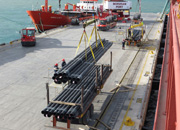
We offer professional global logistics services to EPC contractors and distributors across the Middle East, Southeast Asia, Africa, Europe, and the Americas. To ensure product integrity, every pipe is carefully packaged with protective end caps, anti-corrosion coatings, and reinforced steel bundling to prevent transit damage. Our flexible shipping options include full container loads (FCL), break bulk, and large-scale vessel transportation for bulk orders. Backed by complete export documentation, mill test certificates (MTC), and real-time tracking, we guarantee safe, efficient, and on-time delivery for your critical pipeline projects.
How to Choose Between COE and UOE Pipes for Your Project
Selecting between COE and UOE large-diameter welded pipes is a critical engineering decision that impacts pipeline performance, installation efficiency, and long-term reliability. The optimal choice depends on balancing geometric precision, strength requirements, and project scale.
If your project demands high geometric accuracy—such as strict roundness, low ovality, and stable diameter consistency—COE pipes are the superior choice. Their continuous forming method ensures controlled deformation with lower residual stress, making them ideal for long-distance transmission pipelines where precise alignment is crucial.
Conversely, UOE pipes excel in heavy-duty applications requiring thick walls and extreme internal pressure resistance. The strong U-ing and O-ing pressing process makes UOE highly suitable for offshore and high-pressure systems. Additionally, UOE offers significant advantages in mass production efficiency, providing a cost-effective solution for large-scale infrastructure projects.
When making your final procurement decision, carefully evaluate your specific operating environment, required dimensional tolerances, installation complexity, and budget. By aligning the pipe manufacturing process with your engineering needs and applicable standards (such as API 5L), you ensure maximum operational stability and cost-efficiency for your pipeline system.
Conclusion: Choosing Between COE and UOE Pipe Forming
The choice between COE and UOE forming processes is a critical decision in large-diameter straight seam welded pipe manufacturing. Both methods meet strict international standards like API 5L but serve distinct engineering needs based on geometric accuracy, stress control, and production scale.
COE pipes utilize continuous, gradual deformation, offering superior inherent roundness, lower residual stress, and excellent dimensional stability. They are the ideal solution for projects requiring high geometric precision and seamless installation alignment. In contrast, UOE pipes rely on a stepwise U-ing, O-ing, and expansion method. This process excels in mass production efficiency and heavy-duty applications, making it perfect for thick-wall, high-strength pipelines.
FAQ:
FAQ 1: Is COE better than UOE for dimensional accuracy?
Yes. COE usually provides better roundness and lower ovality because it uses continuous, gradual forming. UOE achieves accuracy mainly after the expansion stage.
FAQ 2: Which is more common for oil and gas pipelines?
UOE is more widely used for heavy-duty oil and gas pipelines due to its strong forming capacity and suitability for thick-wall pipes.
FAQ 3: Can COE pipes handle high pressure?
Yes. COE pipes can meet high-pressure requirements if produced under API 5L or similar standards, depending on design and material grade.
FAQ 4: What is the main difference between COE and UOE?
COE uses continuous forming, while UOE uses step forming (U-ing and O-ing) plus expansion. This affects accuracy, stress, and efficiency.
FAQ 5: Which has lower residual stress?
COE generally has lower residual stress because deformation is more gradual and evenly distributed.
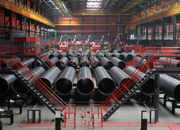 Threeway Steel is known as a professional supplier engaged in manufacturing and distributing a wide range of steel pipe, and our headquarter located the central part of China – Hunan and six associated factories throughout China.
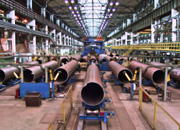 Threeway Steel is known as a professional supplier engaged in designing, manufacturing and distribution of a wide range of steel products with the headquarter located the central part of China – Hunan and six associated factories throughout China.
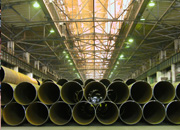 Threeway Steel is known as a professional supplier engaged in designing, manufacturing and distribution of a wide range of steel products with the headquarter located the central part of China – Hunan and six associated factories throughout China.
 Threeway Steel is known as a professional supplier engaged in designing, manufacturing and distribution of a wide range of steel products with the headquarter located the central part of China – Hunan and six associated factories throughout China.
 Threeway Steel is known as a professional supplier engaged in designing, manufacturing and distribution of a wide range of steel products with the headquarter located the central part of China – Hunan and six associated factories throughout China.