09CrCuSb welded steel pipe is a low-alloy steel welded pipe with excellent resistance to sulfuric acid dew point corrosion. It is widely used in flue gas desulfurization systems in industries such as power, metallurgy, and chemicals. Through a rational alloy design, elements such as Cr, Cu, and Sb are added to ordinary carbon steel, giving 09CrCuSb welded steel pipe outstanding corrosion resistance in sulfur-containing flue gas environments, making it a key material in environmental protection equipment.
First, the material properties and chemical composition analysis of the 09CrCuSb welded steel pipe.
The chemical composition of 09CrCuSb welded steel pipe is specially formulated, with Cr content controlled between 0.50% and 1.20%, Cu content between 0.25% and 0.45%, and Sb content between 0.05% and 0.12%. This alloy combination forms a dense protective film on the surface of the 09CrCuSb welded steel pipe, effectively blocking the erosion of corrosive media. Compared to ordinary Q235 steel, the corrosion rate in a 60℃, 50% H2SO4 solution can be reduced by more than 80%, extending the service life by 3-5 times. This 09CrCuSb welded steel pipe also possesses excellent weldability and machinability, with a yield strength of≥295MPa, tensile strength of≥390MPa, and elongation ≥22%, fully meeting the mechanical performance requirements of structural components.
Second, key technologies in the production process of 09CrCuSb welded steel pipes.
The production of high-quality 09CrCuSb welded steel pipes involves several key technologies: First, the steel strip pretreatment process uses pickling and phosphating to ensure the cleanliness of the substrate surface; second, high-frequency welding process control requires precise temperature control between 1350-1450℃, employing dual-gas protection (80%Ar + 20%CO2) to ensure weld quality; finally, the heat treatment process requires post-weld normalizing at 880℃ to eliminate welding stress.
Third, Current Industry Applications of 09CrCuSb Welded Steel Pipes.
In the power industry, 09CrCuSb welded steel pipes are mainly used in key components such as the spray layer of desulfurization towers and flue gas reheaters in coal-fired power plants. A power plant renovation case shows that after using 09CrCuSb welded steel pipes, the equipment maintenance cycle was extended from one year to four years. In the metallurgical industry, they are used in high-temperature, high-humidity, and sulfur-containing environments such as electrostatic precipitators in sintering machine heads and coke oven gas purification systems. Notably, in the chemical industry, this material has also been successfully used in the manufacture of dilute sulfuric acid storage tanks, replacing traditional 316L stainless steel and reducing equipment costs by more than 40%. In 2024, the market demand for 09CrCuSb welded steel pipes in my country exceeded 500,000 tons, with an annual growth rate of around 15%.
Fourth, the quality inspection standard system for 09CrCuSb welded steel pipes.
This product complies with GB/T2975-2018 "Steel Plates and Strips Resistant to Sulfuric Acid Dew Point Corrosion" standard and also meets the requirements of NB/T47003.1-2019 "Technical Specification for Boiler Steel Structure Manufacturing". Key testing items include: intergranular corrosion test (according to GB/T4334), copper sulfate drop test (corrosion rate ≤3.5g/m2·h), and weld X-ray flaw detection (Level II qualified). Third-party testing data shows that the annual corrosion of high-quality 09CrCuSb welded steel pipes in simulated flue gas condensate (pH=1.5) does not exceed 0.25mm, far superior to the 2.0mm annual corrosion of ordinary carbon steel.
Fifth, Precautions for Installation and Use of 09CrCuSb Welded Steel Pipes.
Engineering practice shows that correct installation methods directly affect the performance of 09CrCuSb welded steel pipes: E309L series welding electrodes should be used during welding, and the interpass temperature should be controlled below 150℃; the support spacing for 09CrCuSb welded steel pipes needs to be shortened by 20% compared to ordinary carbon steel pipes to prevent vibration corrosion; when the system is shut down, accumulated liquid should be drained promptly to avoid excessively high local concentrations. A desulfurization project case shows that using cathodic protection (protection potential -0.85V) in conjunction with 09CrCuSb material can further extend the equipment lifespan to more than 8 years.
Sixth, Future Development Trends of 09CrCuSb Welded Steel Pipes.
With increasingly stringent environmental standards, 09CrCuSb welded steel pipe technology continues to innovate: the new generation of products improves corrosion resistance by 30% by adding trace amounts of rare earth elements; the application of intelligent manufacturing technology enables online real-time monitoring of weld quality; modular design promotes the formation of a standardized product system. Industry experts predict that with the advancement of carbon peaking policies, the application of this product in emerging fields such as waste incineration, power generation, and biomass power plants will experience explosive growth from 2025 to 2030.
In summary, 09CrCuSb welded steel pipe, as an environmentally friendly material independently developed in my country, has formed a complete production and application system through more than 20 years of technological accumulation. Users need to comprehensively evaluate its corrosion resistance from multiple dimensions, including material performance, manufacturing process, and testing standards, based on specific operating conditions, to fully leverage its corrosion resistance advantages and provide long-term, reliable material support for environmental protection facilities.
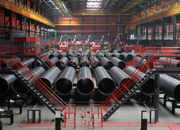 Threeway Steel is known as a professional supplier engaged in manufacturing and distributing a wide range of steel pipe, and our headquarter located the central part of China – Hunan and six associated factories throughout China.
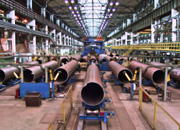 Threeway Steel is known as a professional supplier engaged in designing, manufacturing and distribution of a wide range of steel products with the headquarter located the central part of China – Hunan and six associated factories throughout China.
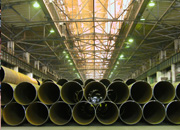 Threeway Steel is known as a professional supplier engaged in designing, manufacturing and distribution of a wide range of steel products with the headquarter located the central part of China – Hunan and six associated factories throughout China.
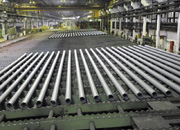 Threeway Steel is known as a professional supplier engaged in designing, manufacturing and distribution of a wide range of steel products with the headquarter located the central part of China – Hunan and six associated factories throughout China.
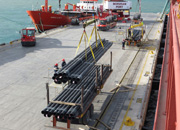 Threeway Steel is known as a professional supplier engaged in designing, manufacturing and distribution of a wide range of steel products with the headquarter located the central part of China – Hunan and six associated factories throughout China.