In modern international construction, projects often involve cross-border material procurement, making steel standard compatibility a critical issue for safety and efficiency. Among the most widely used specifications for cold-formed hollow steel sections are the European standard EN 10219 and the American standard ASTM A500.
While both standards define structural steel used in building frameworks, they are based on different design philosophies, testing requirements, and mechanical classifications. They are not always directly interchangeable. Substituting one for the other without engineering verification can lead to significant risks regarding yield strength, welding performance, and regulatory compliance (Eurocode vs. AISC).
This article provides a detailed comparison between EN 10219 and ASTM A500. It explores their key differences and offers a clear guide for engineers and contractors to safely evaluate material interchangeability, ensuring structural integrity and optimized global supply chain decisions.
What Is EN 10219 Cold-Formed Hollow Section?
EN 10219 is a leading European standard specifying the technical delivery conditions for cold-formed welded structural hollow sections made of non-alloy and fine grain steels. It covers circular (CHS), square (SHS), and rectangular (RHS) hollow sections widely used in load-bearing structures across Europe and international markets following Eurocode design principles.
Unlike hot-finished sections, EN 10219 hollow sections are manufactured at room temperature using electric resistance welding (ERW) or high-frequency welding (HFW) without subsequent heat treatment. This cold-forming process creates a work-hardened structure, offering precise dimensional accuracy and improved strength. The standard strictly controls tolerances for outside dimensions, wall thickness, straightness, and corner radii, making these sections ideal for prefabricated steel construction and modular building systems.
The most common steel grades under EN 10219 include S235, S275, and S355. Among these, S355 is highly favored in structural applications for its 355 MPa minimum yield strength and excellent weldability. The standard ensures structural reliability by defining strict requirements for chemical composition, tensile strength, and minimum elongation (ductility).
Typical applications for EN 10219 sections include building steel frames, stadiums, industrial plants, bridges, and architectural façades. However, when sourcing globally, engineers must carefully compare its specific mechanical properties and tolerances with other standards like ASTM A500 to ensure safe and correct structural equivalence.
What Is ASTM A500 Hollow Structural Section (HSS)?
ASTM A500 is the leading American standard for cold-formed welded and seamless carbon steel structural tubing, commonly known as Hollow Structural Sections (HSS). These circular, square, and rectangular sections are a cornerstone of structural design in North America, extensively used in building construction, bridges, and industrial frameworks following AISC (American Institute of Steel Construction) guidelines.
The standard classifies structural tubing into four main grades: Grade A, Grade B, Grade C, and Grade D. Among these, Grade B and Grade C are the most prevalent in structural applications. Grade C is often selected for demanding designs due to its higher minimum yield strength (typically 345 MPa), while Grade B offers a balanced performance for general use.
ASTM A500 HSS is typically manufactured using electric resistance welding (ERW) without mandatory heat treatment, which maintains cost efficiency for large-scale production. The standard ensures structural reliability by defining strict requirements for minimum yield strength, tensile strength, and elongation (ductility). While it sets acceptable tolerances for dimensions and wall thickness, they are generally considered slightly more flexible compared to the tighter European EN 10219 standards.
Typical applications include building columns and beams, truss systems, space frames, and architectural steelwork. When integrating ASTM A500 into international projects alongside EN 10219 sections, engineers must carefully compare their mechanical properties and design codes to ensure proper structural equivalence and safety compliance.
EN 10219 vs ASTM A500: Key Differences and Technical Comparison
EN 10219 and ASTM A500 are the two globally recognized standards for cold-formed hollow structural sections (HSS). While both are used for similar structural applications, they are built on different design philosophies and technical requirements.
|
Comparison Category
|
EN 10219 (European Standard)
|
ASTM A500 (American Standard)
|
|
Standard System
|
Eurocode-aligned. Emphasizes material consistency and limit state design.
|
AISC-aligned. Focuses on minimum strength and practical performance.
|
|
Grade Classification
|
Numerical yield strength. Common grades: S235, S275, S355.
|
Alphabetical grades. Includes Grade A, B, C, D (Grade C ≈ S355).
|
|
Dimensional Tolerances
|
Stricter tolerances. Tight control over dimensions and corner geometry.
|
More flexible. Acceptable for general structures, less precise for modular systems.
|
|
Chemical Composition
|
Tighter weldability control. Strictly controls composition for consistent welding.
|
More flexible composition. May require specific welding procedure qualifications.
|
|
Structural Design
|
Eurocode (EN). Uses partial safety factors and limit state calculations.
|
AISC (US). Uses Allowable Stress Design (ASD) or LRFD approaches.
|
How to Interchange EN 10219 and ASTM A500 in Real Projects
Interchanging EN 10219 and ASTM A500 hollow structural sections is common in international steel construction. However, because the two standards are based on different design codes and safety philosophies, substitution must never be a simple one-to-one replacement. It requires careful engineering verification rather than assumed equivalence.
|
Evaluation Step
|
Key Action & Considerations
|
|
1. Identify Design Code
|
Align with governing code. Verify Eurocode vs. AISC requirements, ensuring materials meet specific load factors and safety margins.
|
|
2. Match Mechanical Properties
|
Compare actual performance data. Do not match by grade name. Evaluate yield strength, tensile strength, and elongation (e.g., S355 vs. Grade C).
|
|
3. Evaluate Weldability
|
Review fabrication behavior. EN 10219 has tighter chemical controls. Using ASTM A500 may require updated Welding Procedure Specifications (WPS).
|
|
4. Check Dimensional Tolerances
|
Verify fit-up compatibility. Ensure the more flexible ASTM A500 tolerances do not compromise connection details or high-precision assembly.
|
|
5. Perform Recalculation
|
Validate structural safety. Conduct full recalculations for load capacity and stability. Formal engineer approval is mandatory before substitution.
|
Recommended Structural Steel Hollow Sections and Global Supply
We supply a comprehensive range of certified structural steel hollow sections tailored for international construction projects. Our inventory fully complies with both EN 10219 (S235, S275, S355) and ASTM A500 (Grade B, C, D) standards, offering Circular (CHS), Square (SHS), and Rectangular (RHS) hollow sections to meet Eurocode and AISC design requirements.
Every product undergoes rigorous quality assurance, including mechanical testing, dimensional inspection, and weld integrity checks, with Mill Test Certificates (MTC) provided for full traceability. We also offer custom fabrication services, such as cut-to-length processing and galvanized or coated surface finishes, to optimize material performance for your specific project.
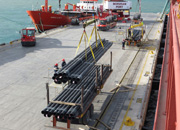
Backed by a reliable global logistics network, we provide seaworthy export packaging, complete documentation, and fast delivery to Europe, North America, the Middle East, and beyond. Our end-to-end supply solutions ensure consistent quality and smooth execution for large-scale infrastructure and industrial projects.
Conclusion: EN 10219 vs ASTM A500 for Hollow Sections
The comparison between EN 10219 and ASTM A500 hollow structural sections highlights a key reality in modern steel construction: similar appearances do not guarantee direct engineering equivalence. While both define cold-formed steel sections, they operate under different design codes (Eurocode vs. AISC), material classifications, and safety philosophies.
Although grades like EN 10219 S355 and ASTM A500 Grade C may seem comparable in yield strength, true equivalence requires evaluating elongation, chemical composition, weldability, and specific design safety factors. Therefore, direct substitution without formal engineering review and structural recalculation is never recommended.
FAQ:
(1) Can EN 10219 replace ASTM A500 in structural design?
Explanation of engineering approval and equivalency checks
(2) Is ASTM A500 stronger than EN 10219?
Comparison of Grade C/D vs S355 steel properties
(3) What is the main difference between HSS and CHS/RHS/SHS?
Terminology clarification between US and EU systems
(4) Which standard is better for export steel structures?
Depends on project region, code requirements, and client specification
 Threeway Steel is known as a professional supplier engaged in manufacturing and distributing a wide range of steel pipe, and our headquarter located the central part of China – Hunan and six associated factories throughout China.
 Threeway Steel is known as a professional supplier engaged in designing, manufacturing and distribution of a wide range of steel products with the headquarter located the central part of China – Hunan and six associated factories throughout China.
 Threeway Steel is known as a professional supplier engaged in designing, manufacturing and distribution of a wide range of steel products with the headquarter located the central part of China – Hunan and six associated factories throughout China.
 Threeway Steel is known as a professional supplier engaged in designing, manufacturing and distribution of a wide range of steel products with the headquarter located the central part of China – Hunan and six associated factories throughout China.
 Threeway Steel is known as a professional supplier engaged in designing, manufacturing and distribution of a wide range of steel products with the headquarter located the central part of China – Hunan and six associated factories throughout China.