Large-diameter straight seam submerged arc welded steel pipes are mainly used for pipeline transportation of marine and onshore oil and gas, petroleum and natural gas, coal and ore slurries, etc. They are particularly suitable for my country's ongoing "West-East Gas Pipeline" project and can also be used for export and import substitution.
International pipe manufacturing technology processes and characteristics: Foreign methods for producing large-diameter straight seam submerged arc welded steel pipes include: UOE method, CFE roll forming method, RBE roll bending forming method, JCOE forming method, C forming method, PFP progressive bending forming method, etc. A brief introduction is as follows:
1. UOE method for manufacturing large-diameter straight seam submerged arc welded steel pipes: First, the pre-bent steel plate is pressed into a U-shape in the forming mold of a U-press, and then pressed into an O-shape in the forming mold of an O-press. After welding into a pipe, the overall diameter is expanded. The Unsoldered Oven (UOE) method is one of the most advanced forming methods internationally. Currently, there are nearly 30 such forming and welding steel pipe units worldwide. The UOE method is renowned for its high production efficiency and good product quality, but it is expensive and requires a large investment.
2. The CFE method for manufacturing large-diameter straight seam submerged arc welded steel pipes: The CFE method's roll forming machine consists of a pre-forming frame, a flat roll frame, edge bending rolls, and a small roll frame. Due to the numerous identical small rolls, the trajectory of the steel plate edge during forming is almost straight, avoiding the "edge stretching" phenomenon. The CFE method produces high-quality pipes, with product quality indistinguishable from the UOF method. This method uses hot-rolled strip steel coils as raw material, unlike other forming methods. It is mainly suitable for large-volume, single-variety steel pipe production, but it is difficult to produce high-strength, thick-walled steel pipes and large-diameter steel pipes.
3. RBE (Roll Forming) method for manufacturing large-diameter straight seam submerged arc welded steel pipes: Steel plates are rolled multiple times between three or four rollers. The welded steel pipes produced by this method have performance and reliability close to UOE (Ultra-Oe) welded steel pipes. The RBE method requires less investment, allows for quick plant construction, offers moderate output, and is highly flexible, making it adaptable to various markets. In recent years, this method has been adopted in some developing countries. However, due to the lack of support in the middle of the forming roller, the diameter of the formed steel pipe cannot be less than 508mm (20in) due to rigidity limitations, reducing market share. Many pipes in my country have diameters below 508mm.
4. JCOE (Joint Coiling and Forming) method for manufacturing large-diameter straight seam submerged arc welded steel pipes: First, the steel plate is pressed into a J-shape on a hydraulic press. After pressing the edges, it is repeatedly stamped into a C-shape, and finally pressed into an O-shape using a semi-O-shaped upper die. The JCOE method produces products with quality close to UOE welded steel pipes, while the production line price is much lower than that of UOE units, but its production efficiency is low.
5. C-forming method for manufacturing large-diameter straight seam submerged arc welded steel pipes: Two C-forming machines replace the U-press and O-press in the UOE unit. The forming process is as follows: half of the pre-bent steel plate is first formed on one press, and then the other half is formed on the other press, thus obtaining an O-shaped round pipe. The welded steel pipes produced by the C-forming method have suitable dimensions, moderate output, and lower production line costs.
6. PFP progressive bending forming method for manufacturing large-diameter straight seam submerged arc welded steel pipes: The pre-bent steel plate is gradually bent on a press with small step sizes and a large number of bends, and finally formed into a round pipe by a steel pipe welding machine. Because the PFP method has a small reduction per bend, the press tonnage is not large, and therefore, the investment is also smaller. This method can form welded steel pipes of different diameters and wall thicknesses, and the processed diameter can be less than 406mm. The quality of the produced welded steel pipes is good, and the output is moderate.
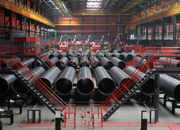 Threeway Steel is known as a professional supplier engaged in manufacturing and distributing a wide range of steel pipe, and our headquarter located the central part of China – Hunan and six associated factories throughout China.
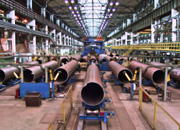 Threeway Steel is known as a professional supplier engaged in designing, manufacturing and distribution of a wide range of steel products with the headquarter located the central part of China – Hunan and six associated factories throughout China.
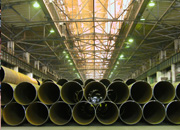 Threeway Steel is known as a professional supplier engaged in designing, manufacturing and distribution of a wide range of steel products with the headquarter located the central part of China – Hunan and six associated factories throughout China.
 Threeway Steel is known as a professional supplier engaged in designing, manufacturing and distribution of a wide range of steel products with the headquarter located the central part of China – Hunan and six associated factories throughout China.
 Threeway Steel is known as a professional supplier engaged in designing, manufacturing and distribution of a wide range of steel products with the headquarter located the central part of China – Hunan and six associated factories throughout China.